
Cognitive Overload: Why High Performers Find It Hard to Switch Off After Work
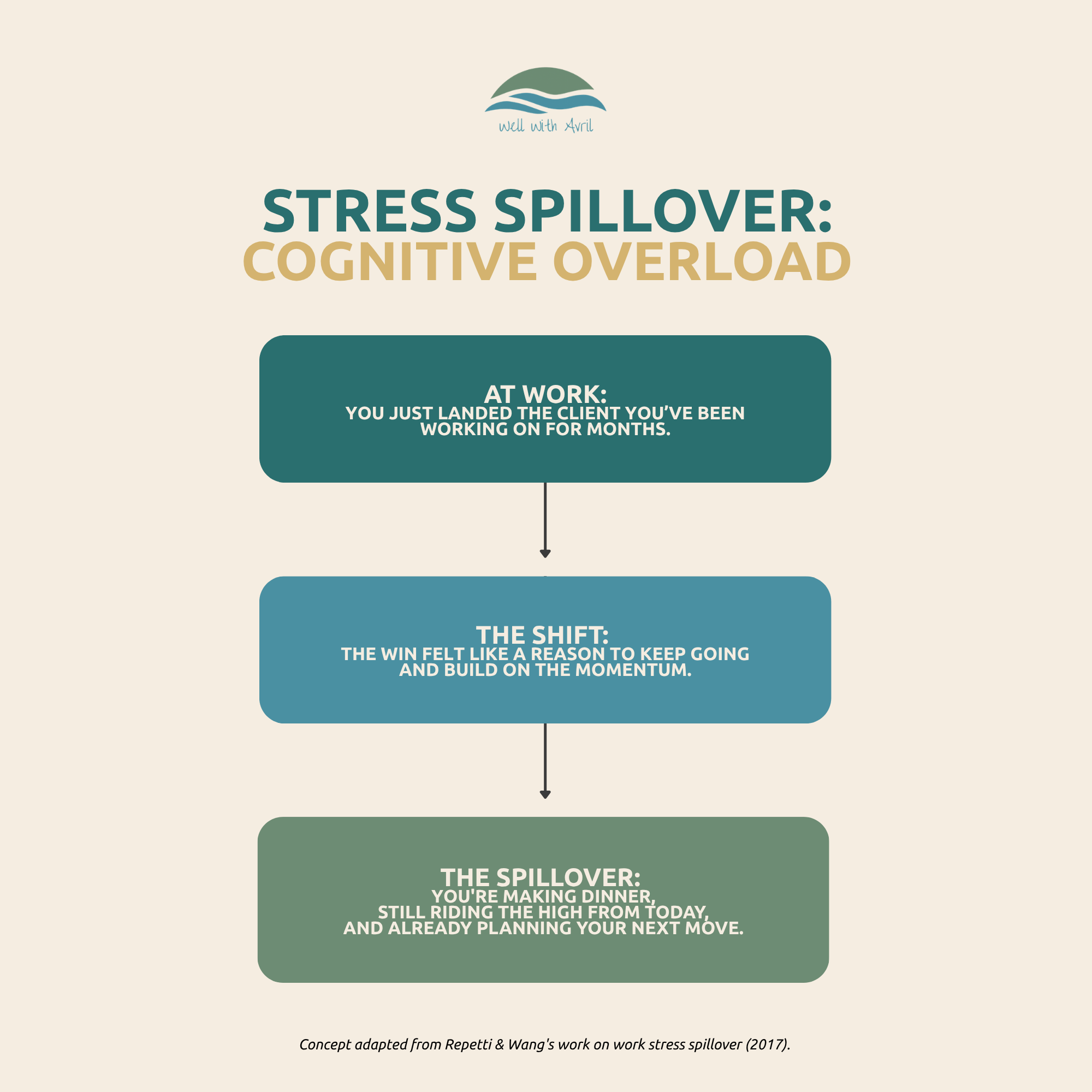
You know how a bad day at work bleeds into home life? Turns out a good day does too. For reasons that have nothing to do with what went wrong, and everything to do with what your brain does with a win.
A bad day at work follows you home because you’re still hung up on what you could’ve done differently. You’re replaying difficult conversations, having second thoughts on your decisions, wondering if you missed something important. Your mind keeps trying to solve a work problem.
A good day can do the exact same thing, just pointed in the opposite direction. Instead of replaying a scenario, you’re thinking about what’s next, trying to keep the momentum going.
Psychologist Hans Selye coined the term eustress in the 1970s. It’s the "good" stress that comes from excitement, momentum, or a win. It activates the same stress response in the body as distress or the “bad” kind of stress. In essence, our brain doesn't fully distinguish between "I need to fix this" and "I need to build on this."
When that stress response barely gets the chance to switch off, it builds into what we call cognitive overload.
What is Cognitive Overload?
Psychologist John Sweller defined cognitive load as "the mental effort that a task requires" (Sweller, as cited in Wigert & Sutton, 2023). Cognitive overload takes place when that load builds up based on what you're doing, the conditions you're doing it in, and what the task requires of you to perform well. When it becomes too much, it gets harder to think creatively or follow through on what needs to get done.
What does Cognitive Overload look like?
For high performers, it can look like being highly organized, thinking three steps ahead, staying on top of everything, or constantly looking for the next thing to improve.
Hayley Walker, one of our coaching clients, loved her work. And because she cared so passionately, work slowly spilled over to every part of her life. Even while on vacation, she would still check her emails just in case something came up.
She kept herself available all the time with her mind constantly on work mode even when she wasn’t physically clocked in.
When the mind is focused on what's next, it's harder to recover from what's already happened. Sleep researchers describe stress and sleep as competitors for the same part of the brain (American Academy of Sleep Medicine, 2008). When stress is winning, your mind won't power down, even hours after the workday ends.
It can also look like:
Thinking about work long after you've gone home
Mentally going through tomorrow’s to-do list
Replaying conversations or decisions
Feeling like you should always be doing something productive
Checking email or messages for any urgent tasks
Struggling to be fully present with family or friends
Having difficulty falling asleep because your thoughts keep moving
Notice: What would it actually take for your mind to clock out at the end of the day?
How do we work with Cognitive Overload in coaching?
Through our evidence-based framework, we start with small, specific goals.
For Hayley, that looked like experimenting with sustainable micro-breaks throughout her workday: looking away from the screen for a few minutes, standing up, drinking water, or doing a quick stretch.
She shared, “Even a 2-3 minute break with some mindful breathing made my mind feel clearer.”
This approach helped Hayley take a full two-week break from work without checking a single email. When she came back, she didn’t feel behind or overwhelmed and simply picked up where she left off.
This experimentation was part of how Hayley worked through her cognitive overload in coaching.
Why Recognizing Stress Patterns Early Matters
The hardest patterns to catch are usually the ones that already feel like routine.
If something feels off in your body, relationships, or daily life, it’s worth asking what’s driving it.
Recognizing a pattern early gives you a chance to understand it before it starts feeling like who you are.
If you want to go deeper, the Stress Pattern Self-Check walks you through all patterns so you can better understand where stress is actually showing up in your life, and find a starting point for change.
If you're ready to take the next step, a 1:1 coaching session can help you understand your patterns more closely and explore ways to work with them.
Explore all eight stress patterns: When Success Drowns Out Stress: How daily work stress reshapes life outside of work
References:
American Academy of Sleep Medicine. (2008). Bring work to bed: The war between stress and sleep. Sleep Education. https://sleepeducation.org/war-between-job-stress-sleep/
Wigert, B. G., & Sutton, R. I. (2023). Too many bosses, too many teams: Overcoming the challenges of team innovation in matrix organizations. In R. Reiter-Palmon & S. Hunter (Eds.), Handbook of organizational creativity: Leadership, interventions, and macro level issues (2nd ed.). Academic Press. https://www.sciencedirect.com/science/article/pii/B9780323918411000257
