
Consistency Looks Different During a Busy Season: How Smaller Versions of Your Routines Can Keep You Going
If you're the kind of person who leads at work, shows up for everyone, and takes pride in doing things well, that same care probably follows you home. At work, going all in is often what makes things succeed. However, bringing that same standard to your routines makes it harder to keep them going when life gets busy.
It could look like:
The full hour at the gym, or nothing.
The full journal entry, or nothing.
The full 20 minutes of meditation, or it's not worth sitting down for.
Then a busy week hits, and the full version isn't realistic anymore.
Instead of going bare minimum, you drop it. You tell yourself you'll get back on track once things calm down.
After years of working with clients, I've learned that consistency usually isn't the real issue when habits fall apart. More often, you're staying consistent with the wrong version of the habit, one that only works when life is calm.
How Busy Seasons Affect Your Habits
When you're stretched thin, you have less capacity to give. There's a concept for this: capacity collapse.
In his writing on conflict, Dr. Irvine Nugent (2026) talks about how our capacity doesn't always disappear all at once. Under pressure, something usually starts to go first: whether that's patience, curiosity, or clarity. Noticing what changes first can give you a clue that you're getting close to your limit.
Leah Weiss (2026) writes about capacity collapse in the context of capable people carrying more than they can keep holding. One thing I find useful in her perspective is the reminder that when we're stretched too far, what starts slipping isn't necessarily a reflection of who we are. Sometimes it's simply a sign that we're asking more of ourselves than we have room for.
You might still be getting everything done at work. You're answering emails, making decisions, handling problems. But you have less room for everything else.
And that can make the routines that usually support you harder to maintain.
I saw this play out with one of my clients. As we worked together, we built this decision path to help her pause before automatically taking on another task or commitment. It gave her a way to move through busy weeks with more intention and make room for things outside of work too.
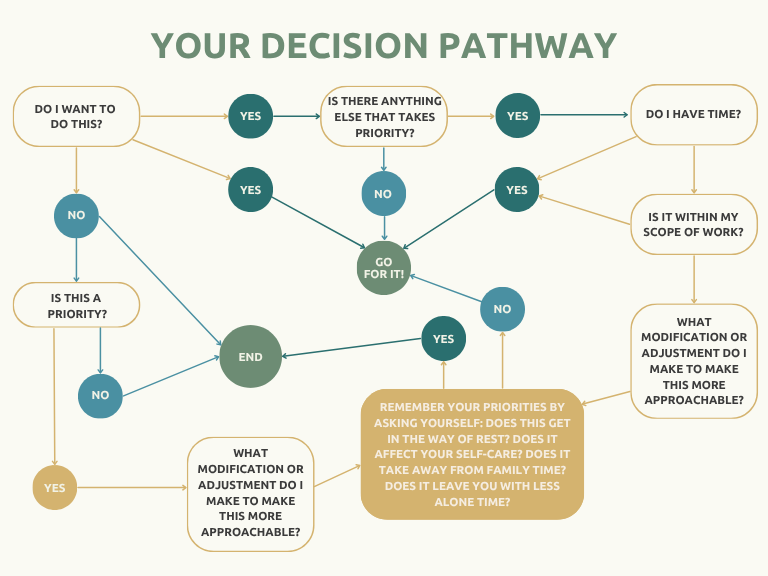
So instead of immediately thinking, “Why can't I keep up with this?” you can pause and ask: Do I actually want to do this? Is it a priority right now? Do I have the time? What could I adjust?
How Smaller Habits Can Help You Stay Consistent
When you're building a habit, repetition gives your brain more opportunities to learn and adapt. That's part of neuroplasticity, the brain's ability to change and adapt by modifying its neural pathways through experience (Fisher, 2025).
During a busy season, you don't have to keep doing the full version of your routine to keep practicing the habit. You just need to make them simpler and smaller.
James Clear talks about this idea in Atomic Habits, where he encourages starting with smaller versions of habits when the bigger version feels difficult to maintain.
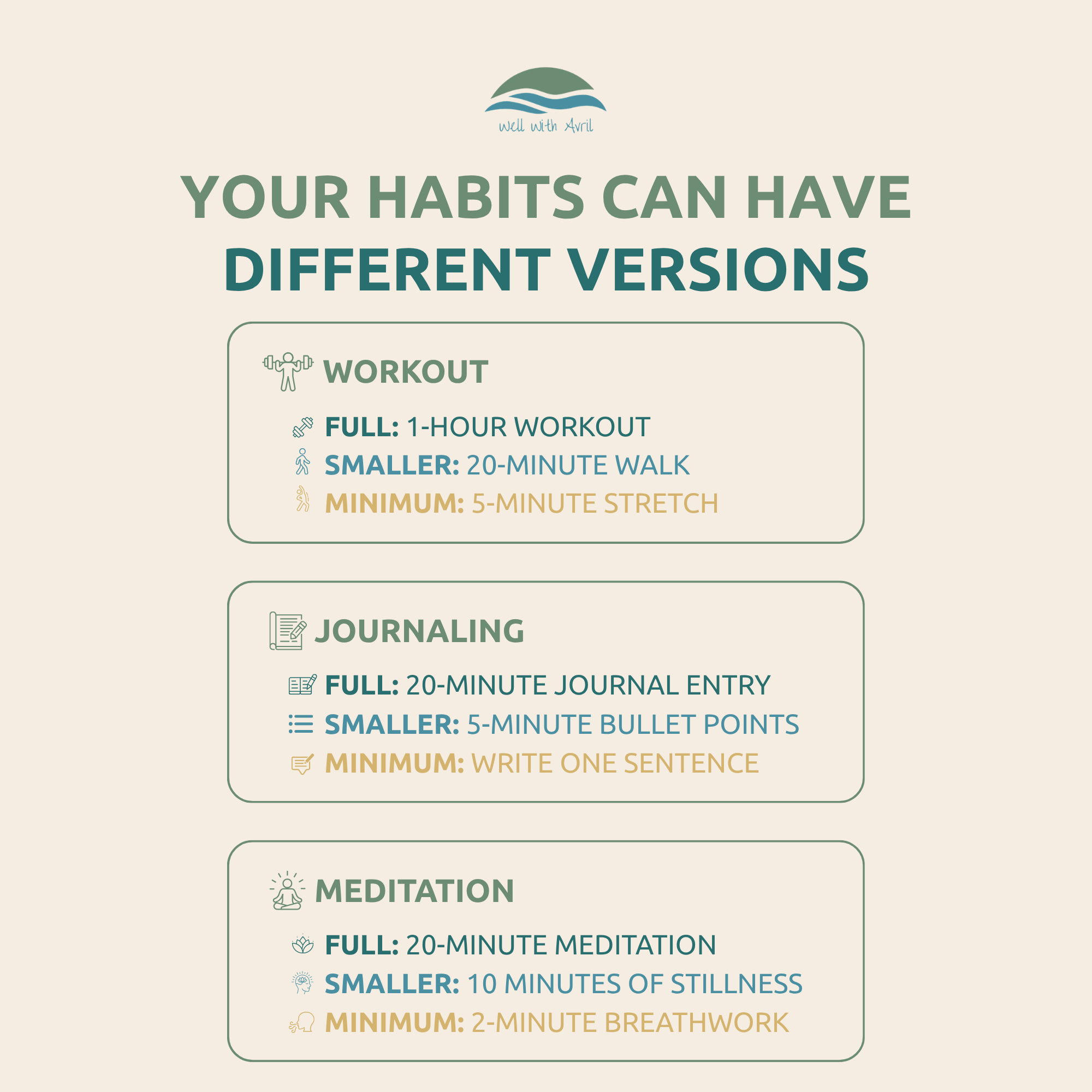
So when a busy season throws off your usual routine, you can still keep a smaller version going. The full workout might not fit, but a quick session could. You might not have the energy for a full journal entry, but you could write a single line. And if 20 minutes of meditation feels like too much, a few minutes can still give you a chance to practice.
The idea of a minimum viable habit takes this a step further: having a small baseline you can return to when your usual routine doesn't fit. What that looks like will be different for everyone. And you might need to try a few versions before you find one that actually fits your life.
How to Adapt Your Habits During a Busy Season
Once you’ve found a smaller version of a habit, the next step is figuring out what actually works for you. You don’t have to get it right on the first try. Think of it as giving yourself a few options and seeing what feels realistic when life gets busy.
Spot your “fair-weather” habits: Which routines are easiest to keep when your schedule is light, but quickly disappear when work picks up?
Find your minimum: What’s the smallest version you could still do on a busy day?
Give yourself options: What could this habit look like on a great day, a normal day, or a really busy one?
Redefine success: If you did the smaller version, let that count. You kept the habit going.
Start with these questions to help you work through it:
Which personal routine do you immediately abandon the moment a work deadline hits?
Is your all-or-nothing mindset convincing you that a small effort isn't worth doing?
What is the minimum viable habit you can commit to keeping alive during your next high-stress work sprint?
If you want to go a little deeper, the Stress Pattern Self-Check can help you understand your current capacity and learn what might be affecting your routines.
Final Thoughts: Small Habits Still Count
There will always be weeks when you can't do everything. That doesn't have to mean you lose the routines that help you feel like yourself. You can make them smaller, give yourself some room, and pick them back up when you have more to give.
And if you're having a hard time figuring out what needs to change, that's something we can work through together in 1:1 coaching.
References:
Fisher, J. (2025, April 2). Tips to leverage neuroplasticity to maintain cognitive fitness as you age. Harvard Health Publishing. https://www.health.harvard.edu/mind-and-mood/tips-to-leverage-neuroplasticity-to-maintain-cognitive-fitness-as-you-age.
Nugent, I. (2026, March 26). Conflict isn't the problem. Capacity collapse is. LinkedIn. https://www.linkedin.com/pulse/conflict-isnt-problem-capacity-collapse-irvine-nugent-phd-3n1mc/.
Weiss, L. (2026, January 30). It’s not burnout. It’s capacity collapse: Why so many capable people are reaching their limit at once. Substack. https://phdl.substack.com/p/its-not-burnout-its-capacity-collapse.
