
When Success Drowns Out Stress: How daily work stress reshapes life outside of work
Your laptop's been closed for two hours. By most measures, it was a productive day. Deadlines were met, meetings went well, and you left work with most of your tasks done.
So why do you still feel so on edge?
Earlier, you snapped at your partner. You ate dinner with your phone face-up, waiting for an email. Your laundry’s been sitting for two days because you just don’t have the energy to face it. Now, at almost 10 PM, you're wide awake, clinging to the one hour that feels like yours.
For high performers, stress rarely touches performance or productivity. Instead, it shows up in your evenings, your relationships, and your ability to be present once work is done.
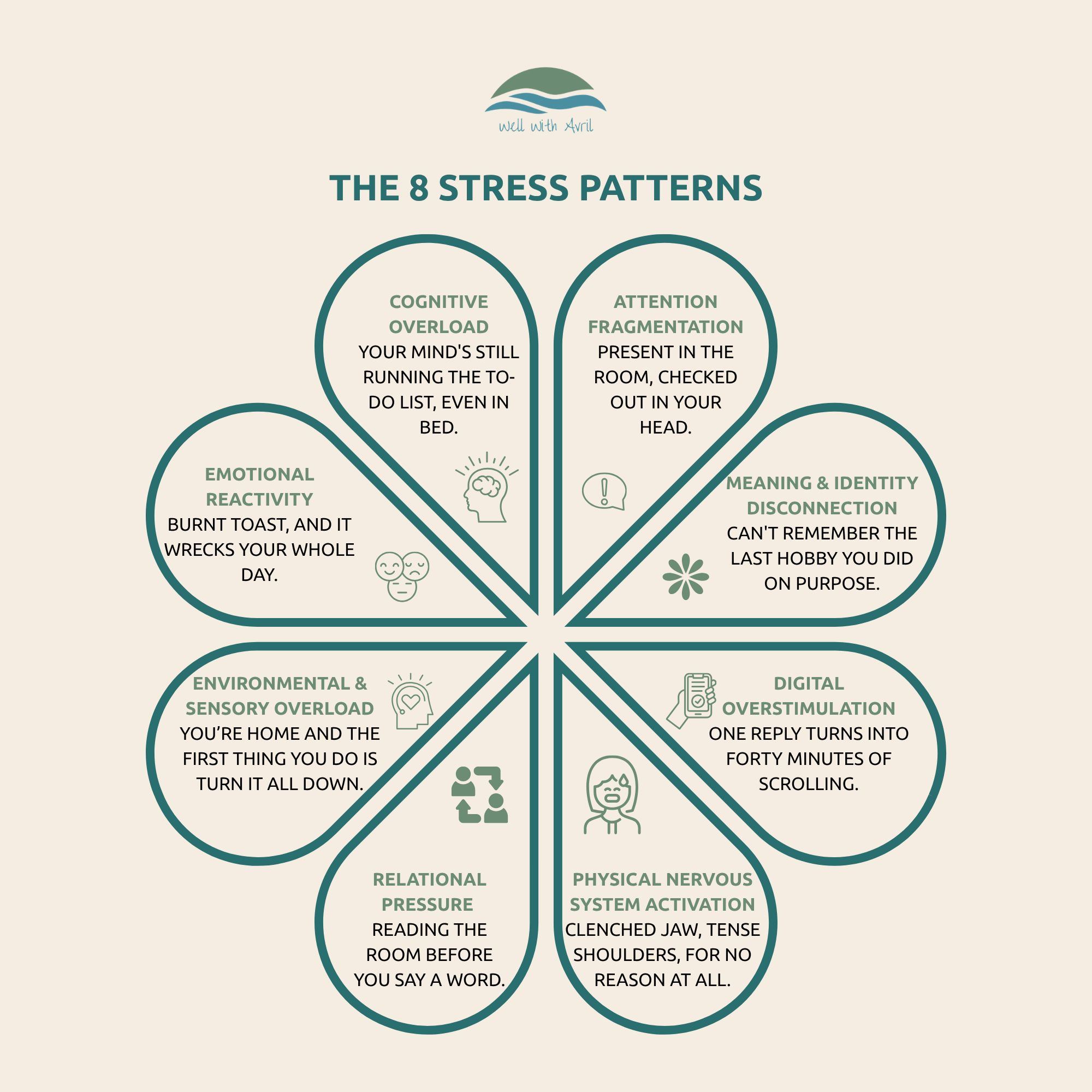
If you're keeping up with everything and still ending most days drained, these eight daily stress patterns may explain why.
Why Stress Is Easy to Miss in High Performers
If there's one thing being good at your job does, it's that success drowns out stress.
People still come to you when something needs to get done, and you deliver. No one, including you, thinks to call it stress.
Meanwhile, it's already reshaping your day. The smallest things set you off at home, you're scrolling instead of sleeping, you keep telling the same friend "next week" and meaning it less every time.
High performers get rewarded for pushing through and staying available. It’s only a matter of time before it stops feeling like stress and starts feeling like just who you are.
The Eight Stress Patterns in High-Performing People
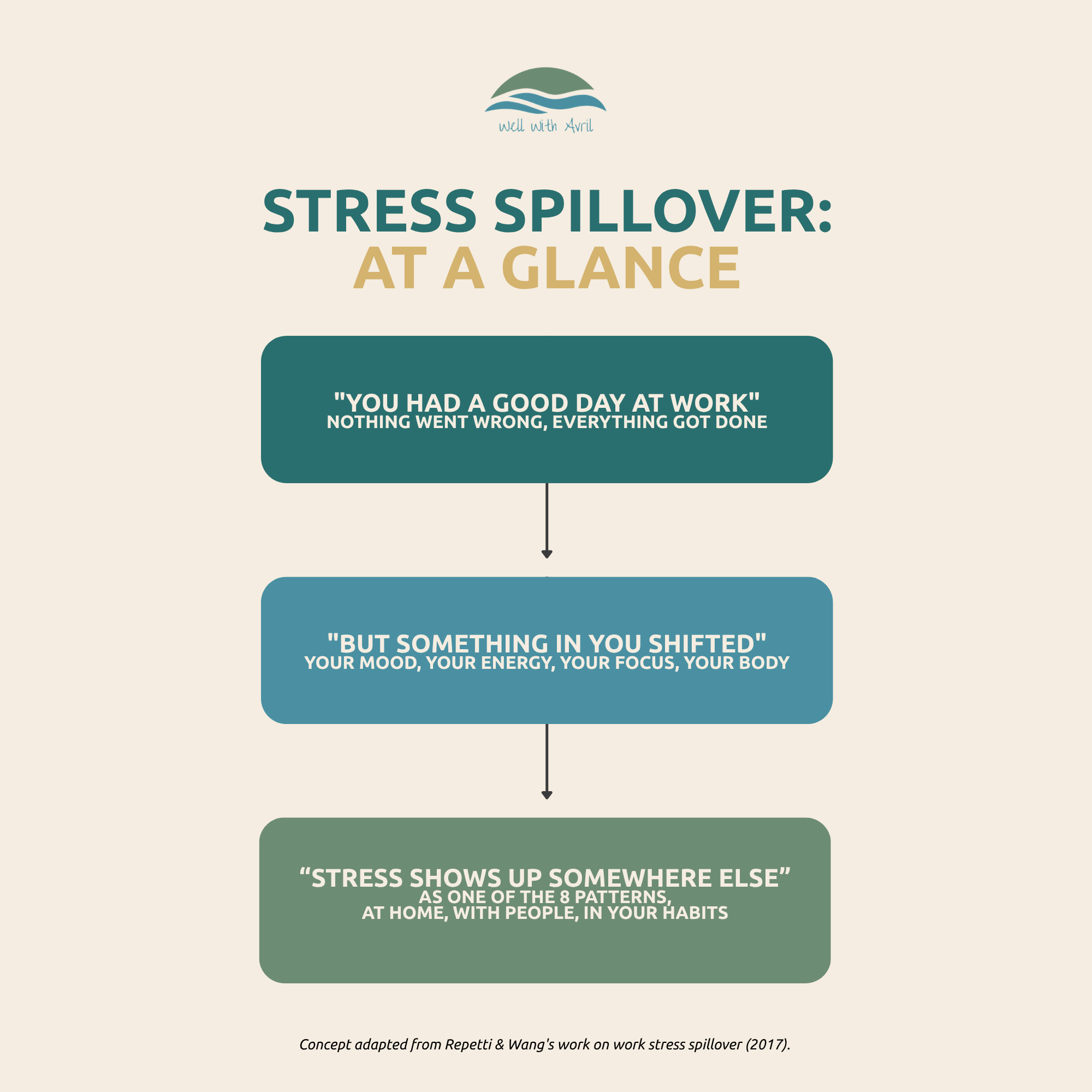
Researchers Repetti and Wang (2017) have a name for this: spillover. It's the idea that a stressful experience doesn't just fade once the setting changes. Its effects stay active, showing up in whatever comes next.
Sometimes it shows up in your thoughts. Sometimes in your body, your habits, or daily routines. Here are eight patterns many high performers recognize in themselves.
-
You're making dinner, but your brain is already in tomorrow's meetings. By the time you get into bed, you're still mentally checking off tomorrow's tasks.
When your mind stays focused on what's next, it's harder to recover from what's already happened. Sleep researchers describe stress and sleep as competitors for the same part of the brain (American Academy of Sleep Medicine, 2008). When stress is winning, your mind won't power down, even hours after the workday ends.Notice: What would it actually take for your mind to clock out at the end of the day?
-
You realize halfway through a movie that you have no idea what just happened. You've been staring at the screen the whole time, just not actually watching it.
Try to recall: What were you physically present for today but mentally absent from?
-
A friend asks what you've been up to for fun lately, and you go quiet trying to think of an answer. You used to have hobbies. Now you can't remember the last time you made time for one.
Sit with this: What's something you used to enjoy before, and how can you make even a little room for it again?
-
You open your phone to reply to one message. Forty minutes later, you're still scrolling and somehow feel more tired than before you picked it up.
Ask yourself: What does your screen time actually look like at the end of the day, compared to how it felt in the moment?
-
You're driving home, stopped at a red light, and you notice your jaw is clenched so tight. Your shoulders have been up by your ears the entire ride.
Sometimes stress stays active in the body long after the moment has passed. Left unaddressed, this tension can affect sleep, digestion, and energy, showing up as headaches, fatigue, or a tightness that never fully lets go (Attune Connect, n.d.).
Check in: Where in your body do you feel the tension most, and what were you doing right before you noticed it?
-
You're back home for the holidays, still not fully over a falling out with your sister from last month. You read her mood before you even walk into the room, tired, annoyed, or just quiet, and adjust how you show up before you say anything.
Worth asking: What would it take for you to feel safe showing up as you are, without adjusting for anyone else's mood?
-
You get home and the first thing you do is turn everything down. The TV, the music, the lights. You head straight to your room to be alone. Your brain had enough stimulation for one day.
Pay attention next time: What's the first thing you do the moment you walk through the door, and how does your body respond once you do it?
-
You burnt your toast, and it feels like the worst thing that's happened all week. Small things start hitting bigger than they should.
Sometimes it's not really about the toast. When stress has been building for a while, your emotional capacity is already stretched. Even your coffee might be adding to it. One study found that caffeine can make stress-driven negative moods worse, making small frustrations feel harder to shake off (Roos & Bennett, as cited in UNC Charlotte, 2019).
Before you react next time: What's underneath this reaction, and what would it feel like to pause before responding?
Why Recognizing Stress Patterns Early Matters
The hardest patterns to catch are usually the ones that already feel like routine.
If something feels off in your body, relationships, or daily life, it’s worth asking what’s driving it.
Recognizing a pattern early gives you a chance to understand it before it starts feeling like who you are.
If you want to go deeper, the Stress Pattern Self-Check walks you through all patterns so you can better understand where stress is actually showing up in your life, and find a starting point for change.
If you're ready to take the next step, a 1:1 coaching session can help you understand your patterns more closely and explore ways to work with them.
American Academy of Sleep Medicine. (2008). Bring work to bed: The war between stress and sleep. Sleep Education. https://sleepeducation.org/war-between-job-stress-sleep/
Attune Connect. (n.d.). When work stress begins affecting your personal life. https://attuneconnect.com/when-work-stress-begins-affecting-your-personal-life/
Repetti, R. L., & Wang, S. (2017). Short-term and long-term effects of job stressors on the family. Current Opinion in Psychology, 13, 15–18. https://www.psych.ucla.edu/wp-content/uploads/Repetti-Wang-Current-Opinion-2017.pdf
University of North Carolina at Charlotte. (2019, April 11). Caffeine can darken moods as people face work stress, say researchers. UNC Charlotte Inside. https://inside.charlotte.edu/news-features/2019-04-11/caffeine-can-darken-moods-people-face-work-stress-say-researchers/
