
Protecting Your Summer Rhythm: What the Yamas Can Teach Us About Avoiding Summer Burnout
Summer is like the carefree aunt who’s always traveling the world. Full of energy. Brimming with sunshine and freedom. She’s the lighthearted and fun season of the year. Yet somewhere around July, something shifts.
What started as excitement slowly turns into pressure. According to a Forbes survey, by July, nearly half of adults experience sunshine guilt. It’s the feeling that they should be outside, making the most of the season, even when they’re exhausted.
Summertime sadness hits when we try to fit everything in. The season becomes a "this is what summer should look like" checklist. Without realizing it, we stop asking what we actually want and start responding to what we think we should want.

Yoga offers a surprisingly relevant lens for this through the yamas, the five ethical guidelines that help us relate to ourselves and others with greater awareness. Rather than rules to follow, they can be seen as boundaries that protect our energy and help us move through life with more intention.
They invite us to ask:
"Is this choice coming from alignment or from expectation?"
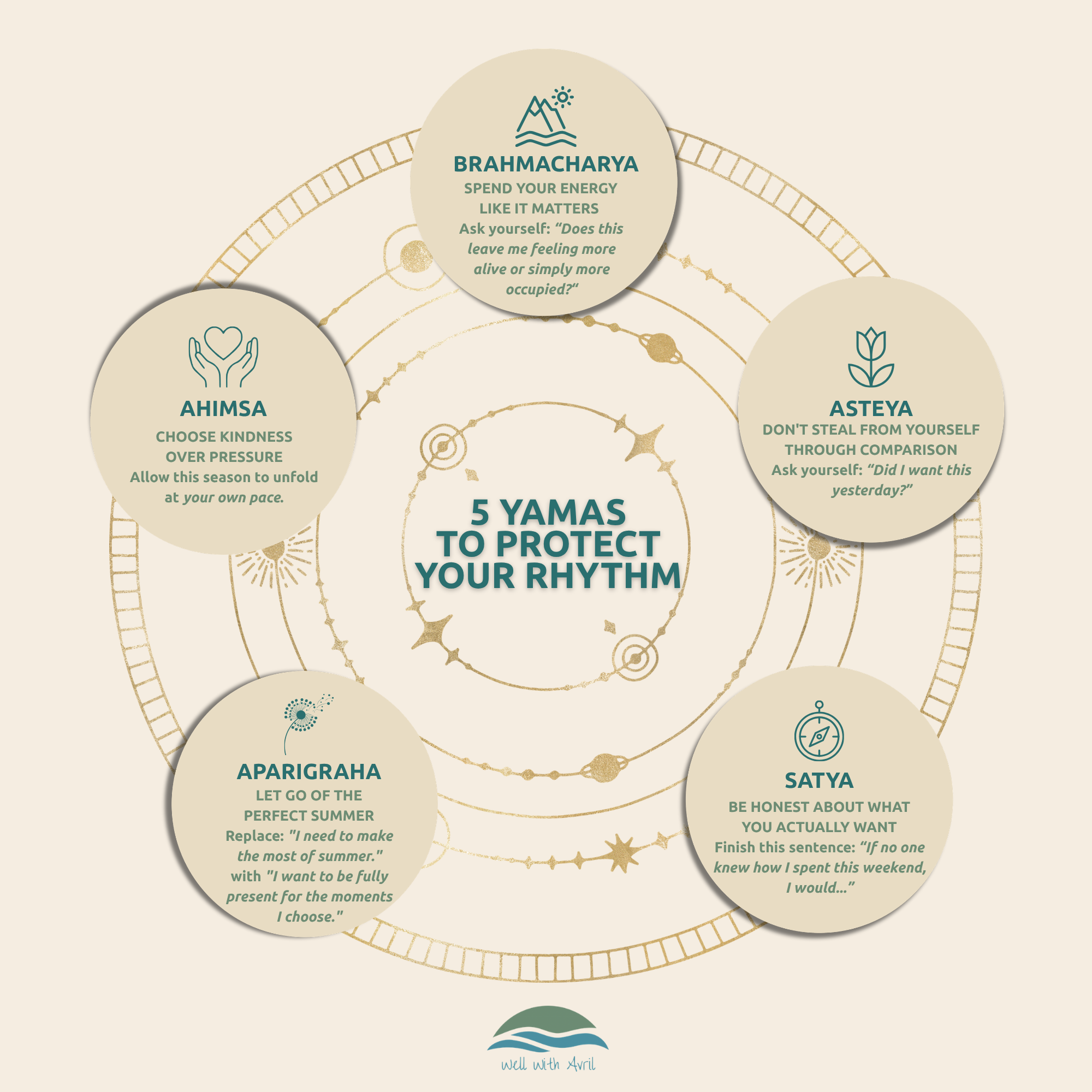
Brahmacharya: Spend Your Energy Like It Matters
Traditionally, brahmacharya is often translated as celibacy or moderation. More broadly, many modern teachers interpret it as the wise use of our life force.
Energy is finite.
Summer often convinces us to spend it as if it isn't.
Every yes costs something:
an early morning after a late night
a weekend that could have been restorative
mental space filled with planning and coordinating
Protecting your summer rhythm means remembering that your energy, not your calendar, is what sets your pace.
Ask yourself: Does this leave me feeling more alive, or simply more occupied?
Practice
Before committing to plans, pause and ask:
Do I genuinely want to do this?
Do I have the energy for it?
What would I be saying no to if I say yes?
Asteya: Don't Steal From Yourself Through Comparison
Asteya is often translated as non-stealing. We usually think of stealing as taking from others. But you’ve likely heard of the saying, “comparison is the thief of joy.” It’s true. Comparison steals your ability to enjoy the day you're already having.
You see someone's camping trip. Someone else's European vacation. Friends paddleboarding every weekend. People making "summer bucket lists."
Suddenly, your peaceful Saturday at home feels inadequate. Comparison, especially with social media, convinces us we're missing out when we may have been perfectly content moments before.
Asteya reminds us not to steal our own contentment by measuring our life against someone else's highlight reel.
Practice
Notice when a new desire appears after scrolling social media.
Ask: "Did I want this yesterday?"
Satya: Be Honest About What You Actually Want
Satya means truthfulness.
Sometimes the hardest person to be honest with is ourselves.
Do you really want another weekend away? Or do you simply feel guilty staying home because everyone else seems busy?
Sometimes our bodies know the truth before our minds admit it. Truthfulness isn't about judging yourself.
Practice
Finish this sentence:
"If no one knew how I spent this weekend, I would..."
The answer often reveals what you genuinely need.
Aparigraha: Let Go of the Perfect Summer
Aparigraha means non-grasping or non-attachment.
Many of us hold tightly to an idea of what summer is supposed to be. Somewhere along the way, many of us unknowingly create an image of the "ideal summer.”
It should be adventurous, productive, social, memorable and beautiful enough to photograph. The tighter we grip that expectation, the harder it becomes to appreciate the summer we're actually living.
Sometimes the most nourishing summer is the least busiest one. It’s the one where you can finally exhale.
Practice
Replace:
"I need to make the most of summer."
with
"I want to be fully present for the moments I choose."
Ahimsa: Choose Kindness Over Pressure
All of the yamas ultimately point back to ahimsa, the practice of non-harming towards others, and especially towards yourself.
Summer burnout rarely comes from one big decision. It comes from hundreds of small moments where we ignore what our bodies are asking for.
Remember, choosing rest over that one more event, one more weekend away, or one more obligation is protecting your ability to enjoy summer to its fullest.
Sometimes the kindest thing you can do is to allow this season to unfold at your own pace.
Protect Your Rhythm With Daily Rituals
One of the simplest ways to stay connected to the yamas and our own rhythm is through gentle rituals.
A morning ritual helps you choose your pace before the world chooses it for you.
An evening ritual helps you release the pressure to keep doing.
Rituals can be as simple as:
taking five slow breaths before checking your phone
stepping outside with your coffee
asking yourself how you want to feel today
ending the day with gentle stretching or journaling
reflecting on one moment that genuinely brought you joy
These small pauses make it easier to notice when you've drifted from "I want" into "I should."
And if you miss your ritual for a day, or even a week, that doesn't mean you've failed. Perfection isn’t a prerequisite for rituals or for anything in life for that matter.
Summer Doesn’t Need to Be Packed to Be Meaningful
The yamas remind us that a fulfilling season is built by staying connecting to ourselves rather than by packing our days with more.
Summer has a way of making us believe we need to squeeze every drop from the season before it slips away. But maybe making the most of summer is simply about being present enough to enjoy what's already here.
The yamas remind us that our energy is worth protecting, our truth is worth listening to, and our pace doesn't need to match anyone else's. Because the best summer isn't the busiest one.
It's the one where you don't lose yourself trying to keep up.
Protecting your energy this summer is really about returning to rhythm, the natural pace beneath all the "shoulds."
Read more about island time, and the rhythm we lost along the way.
Reference: Davis, S. (2024). Nearly 50% Experience Summertime Sadness—Here’s How To Cope With ‘Sunshine Guilt’. Forbes. Retrieved from https://www.forbes.com/health/mind/summer-depression-survey/
