
Living in Rhythm: A Way of Being We’ve Lost
Growing up in the Philippines, “island time” was not something I named or questioned. It was simply how life moved. There was waiting, but not impatience. Plans formed loosely. Time to be together unfolded with daylight, weather, and conversation rather than precise start times. When delays happened, people talked, sat, and connected. Respect for time showed up as patience and presence rather than speed.
Attunement to the moment, to each other, and to what was unfolding mattered more than getting things done. I did not realize how deeply that rhythm lived in my body until I left it. Now, urgency shapes my days far more than I would like.
When Rhythm Gave Way to Urgency: Hurry Sickness
That shift happened gradually over time and changed how my body learned to relate to time. When I later migrated to the United States, my relationship with time shifted. Punctuality sharpened. Being early became a form of respect. Efficiency became proof of care. Even rest carried a sense of pressure, as if it needed structure and justification. My body learned to anticipate urgency.
Stillness began to feel unproductive. Pauses felt indulgent. Slowness felt like something to explain.
Modern life organizes itself around productivity, output, and optimization. Time becomes something to manage rather than something to experience. Days fill quickly. Transitions disappear.
Over time, this pace becomes internal. Meals become rushed. Schedules stack. Rest happens only after exhaustion and often laced with guilt. This pattern does not reflect a personal failure. It reflects a nervous system responding to constant demand.
There is a term that describes this experience: hurry sickness. Cardiologists Meyer Friedman and Ray Rosenman introduced it in the 1970s to describe a persistent sense of urgency that continues even in the absence of true pressure.
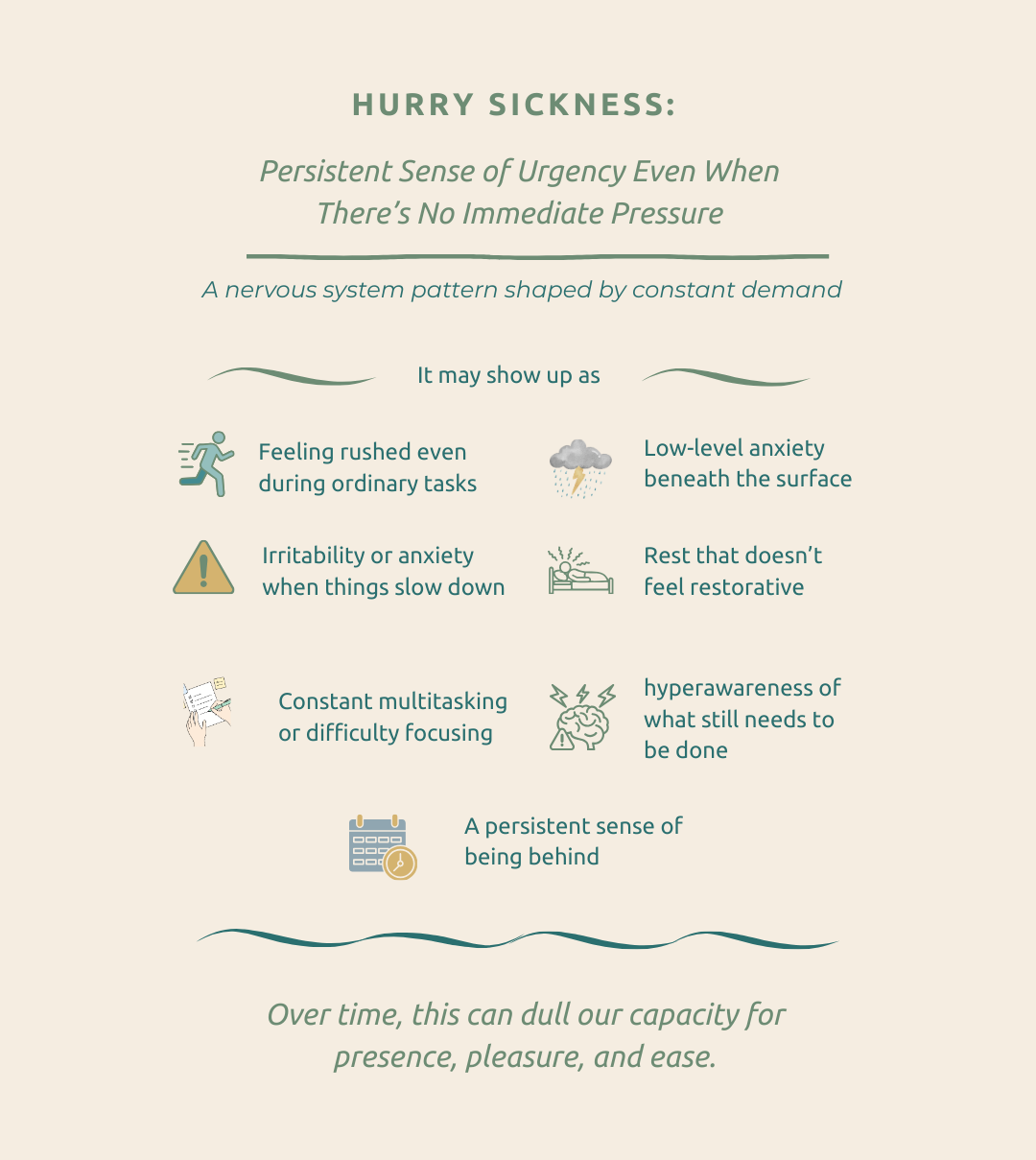
Hurry sickness shows up quietly, but often time insistently. It looks like:
Treating everything, even everyday small tasks like shopping, eating or driving, as a race.
Feeling irritated or anxious by delays.
Constant multi-tasking and difficulty focusing on one task a time.
Struggling to be present when resting.
Low-level anxiety that hums beneath the surface.
Hyperawareness of what still needs to be done
A mind and body that remain alert even during downtime
Feeling perpetually behind schedule.
For many people, this state becomes so familiar that it fades into the background.
It begins to feel normal. Sometimes it even begins to feel necessary. Yet the cost shows up over time with:
Rising burnout
Disrupted sleep, and
A growing sense of disconnect from ourselves and others.
Rushing keeps the body in a state of readiness, where stress hormones stay elevated and true rest becomes harder to access. Over time, this constant activation dulls our ability to feel pleasure, presence, and ease.
And yet, for many of us, a quiet knowing still finds its way in.
It might arrive as a longing to slow down, a desire for more space, or a sense that the pace we live by no longer feels sustainable. At first, this impulse can feel unsettling. The conditioned mind may read it as a loss of drive or ambition. Discomfort often follows when the nervous system encounters a pace it has not trusted for some time. What we are touching instead is something much older: the remembered truth that the human psyche and body is not designed to live in constant urgency. It’s designed for rhythm.
Small Invitations Back to Rhythm
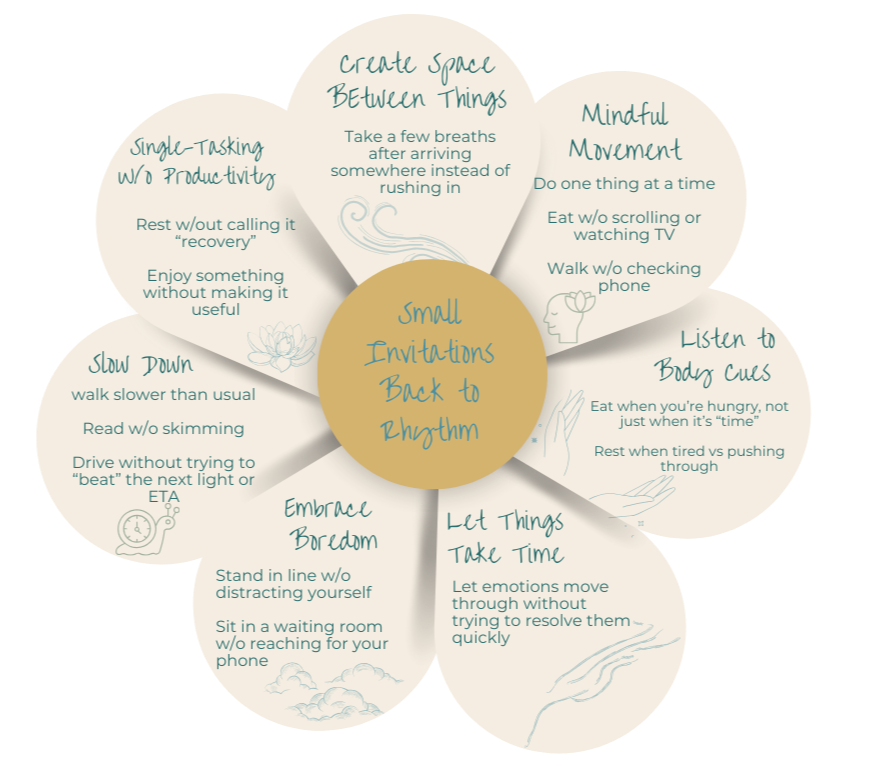
Rhythm is a natural intelligence that exist in the body and in the world around us. We see it in the rise and fall of the breath, the changing of seasons, and the pull of tides. It’s a way of living that allows movement and rest to coexist. In Filipino culture, this kind of natural, continuous flow has a name: daloy (pronounced dah-loy). It’s the same word used to describe the flow of breath, blood, and water.
This remembering does not require rejection of responsibility or modern life. Cultural conditioning teaches us to override tiredness, hunger, and overwhelm. Rhythm invites to trust the natural ebb and flow of our own energy. It asks for balance. It asks to sense when to engage and when to soften. It asks to trust that slower does not mean less effective.
Returning to rhythm does not require dramatic change. It begins with small, intentional shifts to:
-
Do one thing at a time, without pairing it with another task
Eat without watching TV or scrolling
Walk without checking your phone
Let your body fully be where it is, even for a few minutes
Rhythm returns when attention is no longer split.
-
Leave 5–10 minutes unscheduled between commitments
Pause before opening the next tab, email, or conversation
Take a few breaths after arriving somewhere instead of rushing in
Let transitions exist instead of collapsing them
This space helps the nervous system reset, not just the calendar.
-
Sit in a waiting room without reaching for your phone
Stand in line without distracting yourself
Let silence linger in conversation
Allow your mind to wander without redirecting it
Boredom is often the doorway back to presence.
-
Walk slightly slower than usual
Drive without trying to “beat” the next light
Read without skimming
Slowness here is a form of agency, not resistance.
-
Let an action be enough on its own.
Rest without calling it “recovery”
Sit quietly without planning what comes next
Enjoy something without making it useful
Rhythm emerges when doing is no longer justified by output.
-
Eat when you notice hunger, not just when it’s “time”
Rest when tired instead of pushing through
Notice tension before it becomes pain
Take breaks before exhaustion demands them
Rhythm asks for responsiveness, not discipline.
-
Allow conversations to unfold without steering them
Let emotions move through without trying to resolve them quickly
Give yourself time to wake up, wind down, or arrive emotionally
Trust that not everything needs to be sped up
Some things settle only when they are not hurried.
These moments may feel unfamiliar at first. That feeling often reflects a nervous system learning a different way to settle.
Daloy: An Embodied Remembering
Daloy reflects this understanding of rhythm. It points to movement that circulates rather than rushes, adapts rather than forces, and sustains rather than depletes.
In this way, Daloy echoes the rhythm many of us have known before and may still recognize in our bodies, even if we’ve forgotten how to access it. Rather than teaching strategies to slow down, Daloy creates conditions that allow the body to do so naturally. Rhythm replaces rush. Awareness replaces effort. Remembering happens through experience rather than instruction.
The Daloy Retreat supports this reconnection through embodied practice, nature, and intentional spaciousness. It is designed for those who feel the pull toward a steadier pace but struggle to access it within daily life.
If this way of being feels familiar in your body, even faintly, learn more about the Daloy Retreat and registration.
