
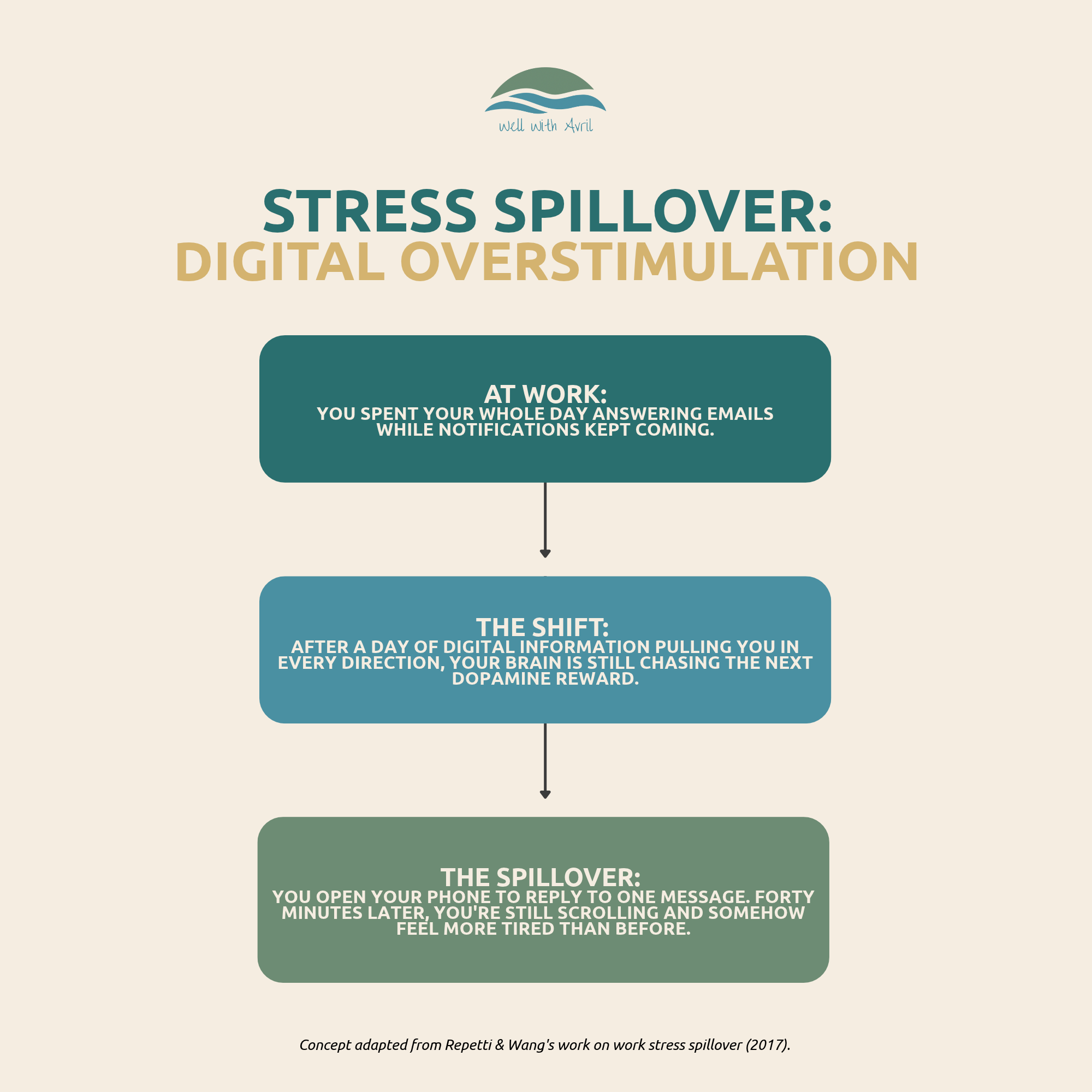
Do you ever feel like your brain can't get a break from your devices? At work, you spend hours in front of a screen being in meetings, answering emails, and responding to endless notifications. You scroll through social media for a quick break and suddenly hours have gone by. You get home mentally exhausted and turn on the TV to decompress and unwind. Then, it's time for bed, but you still feel like your brain is super wired. So you reach for your phone again.
The constant use and rush of digital information is chemically altering the brain. It triggers the dopamine pathways that seeks satisfaction. This seeking system popularly known as the "feel good chemical" doesn’t differentiate between “natural” rewards like food and “artificial” rewards such as digital likes. Because it's easier for the brain to seek out satisfaction through 30 second funny/motivational reels, it becomes addicted. Each notification then feels like a reward turning compulsive checking and scrolling into an addictive loop that's constantly bombarding the brain.
What is Digital Overstimulation?
Psychiatrist Tracy Asamoah, MD (2023) defined digital overstimulation, or digital overload, as what the brain goes through when you spend too much time on your devices which is the unfortunate reality for many busy and stressed professionals, engineers, and consultants in San Francisco. Time online, watching TV, or playing video games can trigger it, and so can taking in too much information or multitasking across media.
What does Digital Overstimulation look like?
Technology is at the center of most workplaces today. High-performing women can develop digital dependence because of this setup.
Claire Armstrong, one of our stress management and lifestyle coaching clients in San Francsico, spent eight years working in startup operations. She managed a global team, while navigating the demands of a fast-paced work environment. She spent her mornings reaching for her phone before she was even fully conscious. At night, she would regularly meet her global team and attend to work crises.
This setup often left Claire feeling too exhausted and discouraged for self-care. Recognizing her stress patterns led Claire to start stress management and lifestyle coaching to alleviate her digital overstimulation.
Claire’s old morning routine shows one of the 14 common sources of microstress we learn to live with. Technology that fragments our attention is one of these small, repeated stressors that seem harmless but build into profound emotional fatigue.
On its own, checking your phone in the morning seems manageable. But over time, harmless checking turns into full working mode. Before you know it, the habit ripples through your nervous system, relationships, and routines, and your work day starts the moment you wake up.
According to Dr. Seng Kok Han of Nobel Medical (2026), digital overload can also look like:
Feeling anxious when your phone is not nearby
Constantly checking notifications without thinking
Difficulty focusing on one task for long periods
Feeling mentally tired despite minimal physical activity
Irritability when interrupted
Poor sleep quality
How do we work with Digital Overstimulation in coaching?
Well With Avril Approach to Stress Management and Lifestyle Coaching
Because changing is hard, and being told what to do rarely helps, at Well With Avril, your coach works alongside you to uncover your internal motivations for change. Even when you feel hesitant or unsure where to begin, there's often a reason part of you wants things to be different. Before setting goals or making changes to improve your wellbeing, your coach helps you explore those motivations, connect them to your personal values, and work through any ambivalence that may be holding you back.
From there, you and your coach identify the stress areas with the greatest impact on your wellbeing and determine where to focus your energy. Throughout the process, your coach provides encouragement, accountability, and support as you experiment with behavioral changes that reflect your needs, priorities, and what matters most to you. You can read more about our evidence-based coaching framework here.
What this Coaching Looked Like in Practice for a Digitally Stimulated AI Start-Up Operations Manager
Together, we identified small routines that could bring more structure to Claire's days without adding more to her plate. Through experimentation, we gradually developed a routine that felt realistic and sustainable for her. We drew on the principles of neuroplasticity, using repetition and small, consistent changes to help her build new patterns of behavior over time.
Protecting her mornings became one experiment that made a lasting difference. Initially, the idea of staying off her phone in the morning felt counterproductive. She worried she would lose valuable time that could otherwise be spent working. But she also recognized that she needed a different way to start her day if she wanted to stop feeling drained by midday.
So, Claire started with just 30 minutes. She gave herself time to wake up, enjoy her coffee, and ease into the day before shifting into work mode. She realized it was much easier than she had anticipated. Those 30 minutes gradually became an hour. She eventually made a habit of checking her inbox for anything urgent only after that first hour had passed.
Six months after her last stress management coaching sessio, the phone she once reached for the moment she woke up had become the least of her morning concerns.
Why Recognizing Stress Patterns Early Matters
The hardest patterns to catch are usually the ones that already feel like routine.
If something feels off in your body, relationships, or daily life, it’s worth asking what’s driving it.
Recognizing a pattern early gives you a chance to understand it before it starts feeling like who you are.
If you want to go deeper, the Stress Pattern Self-Check walks you through all patterns so you can better understand where stress is actually showing up in your life, and find a starting point for change.
If you're ready to take the next step, a 1:1 coaching session can help you understand your patterns more closely and explore ways to work with them.
Well With Avril offers practical self-care and stress-relief tools through 1:1 coaching, yoga, and meditation in the San Francisco Bay Area. No matter where you are on your journey, this is your space to reconnect, realign, and return to yourself.
Explore all eight stress patterns: When Success Drowns Out Stress: How daily work stress reshapes life outside of work
References:
Asamoah, T. (2023). What is digital overload? Definition, symptoms, how to manage. GoodRx. https://www.goodrx.com/health-topic/mental-health/what-is-digital-overload
Katzenstein, J. (2021). Addiction to electronic devices. Johns Hopkins Medicine. https://www.hopkinsmedicine.org/health/conditions-and-diseases/behavior-disorders/addiction-to-electronic-devices
Scala, V. (2026, March 31). What is digital overstimulation and how is it affecting you? Anchor Therapy. https://www.anchortherapy.org/blog/what-is-digital-overstimulation-and-how-is-it-affecting-you-jersey-city-therapist
Seng, K. H. (2026). Digital overload. Nobel Medical Group. https://nobelmedicalgroup.com/health-resources/articles/digital-overload
